
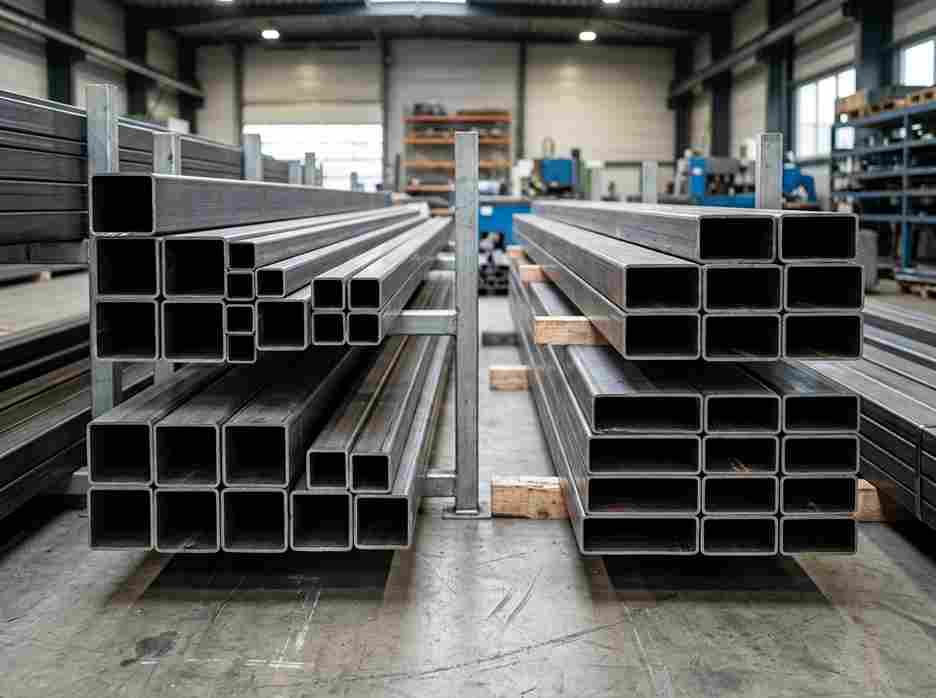
Square Hollow Section vs Rectangular Hollow Section: Which One Should You Choose?
Walk onto any steel fabrication yard in Dubai or Hamriyah Free Zone, and you will spot both square and rectangular hollow sections stacked side by side. Choosing between them is not a matter of preference. The square hollow section depends on the load path, the joint design, and the budget allocated for the structure.
Introduction to Hollow Steel Sections in UAE
Hollow structural sections form the backbone of steel frameworks across the UAE, from warehouse columns in Jebel Ali to offshore support structures along the Gulf coast. Their closed profile resists torsion better than open sections like I-beams, which is why fabricators reach for them in trusses, columns, and bracing systems.
Demand has grown with the industrial growth of Dubai. Logistics parks, marine yards and commercial towers specify square hollow section UAE products or their rectangular equivalents based on the engineering brief.
What is a Square Hollow Section (SHS)?
The Square Hollow Section is a four-sided hollow steel profile manufactured from mild steel coils by cold or hot rolling. Wall thickness typically ranges from 1.6mm to 12mm, with outer dimensions running from 20mm x 20mm up to 400mm x 400mm depending on the mill.
Equal sides mean equal stiffness in both the x and y axes. That symmetry makes SHS the natural choice wherever a column carries load from multiple directions, such as building columns, support legs, and vertical bracing in steel-framed sheds.
In the UAE, square hollow sections in Dubai projects commonly appear in warehouse racking, perimeter fencing, and gate frameworks. Architects also specify it for exposed structural columns in retail and industrial fit-outs where the clean square profile looks better than an asymmetric shape.
What is a Rectangular Hollow Section (RHS)?
A Rectangular Hollow Section shares the same closed-tube construction as SHS, but its two pairs of sides differ in length, commonly ranging from 50mm x 25mm to 500mm x 300mm. That asymmetry shifts the section’s strength toward one axis.
RHS load distribution prefers bending resistance in longer dimensions. To get more strength per kilogram than a square profile gives at the same weight, engineers turn the long side to where the greatest load is, such as a roof purlin between trusses.
Fabricators across UAE steel fabrication shops use RHS for beams, lintels, and horizontal framing members. Marine fit-out yards also specify RHS for deck supports and platform frames, where one direction carries far more load than the other.
Key Differences Between SHS and RHS
Strength behaves differently in each shape. The load is evenly distributed in both directions. The load is concentrated in the longer direction of the RHS, and higher section modulus for the same weight of the beam.
Architectural application is similarly divided. SHS suits visible columns and grid-like facades, since symmetry looks balanced from any angle, while RHS appears mostly in functional framing hidden behind cladding or decking.
Cost in the UAE market tracks closely with weight per meter rather than shape. A 100mm x 100mm SHS and a 120mm x 80mm RHS of similar wall thickness carry comparable price tags, since both consume nearly the same tonnage of mild steel.
Welding differs at the corners. SHS welds present four identical joints, simplifying jig setup for repetitive runs, while RHS requires fabricators to track orientation so the long side lands in the correct load direction during assembly.
| Parameter | Square Hollow Section (SHS) | Rectangular Hollow Section (RHS) |
| Cross-section | Equal sides | Unequal sides |
| Load behavior | Balanced in both axes | Stronger along longer axis |
| Best use | Columns, vertical supports | Beams, purlins, horizontal framing |
| Visual application | Exposed architectural columns | Hidden structural framing |
| Fabrication | Simple, uniform joints | Requires orientation control |
| Typical sizes (UAE stock) | 20mm to 400mm square | 50x25mm to 500x300mm |
Square Hollow Section vs Rectangular Hollow Section: Which is Better?
Neither section outperforms the other across every project. The right choice depends entirely on how the load travels through the member.
Choose SHS when a structural member carries axial load from a column, when bi-directional wind loading applies, or when the finished structure exposes the steel and visual symmetry matters. Warehouse uprights and fence framing fall into this category.
Choose RHS when a member spans a fixed distance and bends primarily under gravity load, such as a roof purlin, floor joist, or platform beam. Orienting the long side vertically increases bending capacity without adding steel weight.
From an engineering standpoint, the calculation reduces to one question: does the load act equally from all sides, or does it concentrate in one direction? Structural engineers run this check during design, and the hollow section specification follows directly from the answer.
Applications in UAE Construction Industry
Commercial buildings across Dubai use SHS for curtain wall support columns and RHS for floor framing between structural bays. Both sections often appear on the same project, assigned to different structural roles.
Industrial structures lean heavily on hollow sections for portal frames, mezzanine supports, and crane gantry legs. Fabrication units that purchase MS pipes in Dubai stock both profiles as per the requirement of the structural drawing.
The use of SHS columns and RHS roof purlins in warehousing and logistics buildings provides a balance between the vertical load capacity and horizontal span efficiency. This combination is repeated time and again in warehouse builds in Jebel Ali and Hamriyah Free Zone.
Steel fabrication industries in Dubai keep both sections in standard 6-meter lengths to avoid cutting waste on large orders. Suppliers of mild steel in UAE stocking both profiles in consistent grades will reduce procurement delays for fabricators working on multiple concurrent projects.
Where to Source Quality Square Hollow Sections in UAE
Material consistency matters more than price when a structural engineer has already specified a grade and tolerance. A supplier working from certified mill sources reduces the risk of dimensional variance between batches, which matters when sections from different deliveries get welded into the same frame.
Look for suppliers who confirm chemical composition, wall thickness tolerance, and mill certification on every batch rather than a general assurance. Square hollow section in Dubai buyers should also confirm stock availability in the exact size range a project needs, since custom rolling runs add lead time that most construction schedules cannot absorb.
Stolt Steels & Alloys FZE, based in Hamriyah Free Zone, stocks square and rectangular hollow sections alongside shipbuilding plates, beams, channels, and flat bars for buyers across the UAE and GCC. Fabricators sourcing structural steel for both marine and land-based projects can pull multiple product categories from a single stockist, which simplifies logistics on multi-material orders.
Conclusion
SHS and RHS solve different structural problems. In columns and vertical supports, square sections are used for balanced, multi-directional loading, whereas for beams and purlins rectangular sections are more efficient in carrying bending loads along their longer axis.
Cost differences between the two stay minimal when wall thickness and weight match, so the deciding factor should be the load path, not the price list. Before ordering, confirm the calculation with your engineer and check that your mild steel supplier in UAE holds the exact size and grade your drawing specifies.